Vampire Pimps: John Hull’s Servile Connivance, Spanberger’s Diversion
Data center developments in the Commonwealth are emblematic of the death of the United States’ constitutional republic. They bring into view, to many of us for the first time, the republic’s replacement by the system called “stakeholder capitalism.”
Stakeholder capitalism recognizes, more or less, three actors: corporate entities, governments, and an amalgam of the first two, public-private partnerships (P3s). In this model, P3s work to create an “enabling environment,” developing local property and resources to attract typically foreign corporations. P3s and corporations then work out deals under cover of nondisclosure agreements and exceptions to the Freedom of Information Act (FOIA). Such negotiations may take years, but the public doesn’t learn about them until government takes a vote to execute the deal, if then.
Wood Haven: The Beginning of a Timeline
We now have enough of a timeline from the Wood Haven property in Roanoke to illustrate this process. Roanoke City, Roanoke County, and Salem formed the Western Virginia Regional Industrial Facilities Authority (WVRIFA), which acquired the Wood Haven property in 2016 for $5.3 million. In 2019 we have documentation from the Roanoke Valley-Alleghany Regional Commission (RVARC) suggesting that a data center was already being considered for that site.
The public-private nonprofit, The Roanoke Regional Partnership (RRP), seems to have taken the lead in bringing Google to Roanoke. The RRP is a good vehicle for secrecy because, as a 501(c)(6) non-profit, it is probably not subject to FOIA requests. John Hull, who is both CEO of the RRP and Executive Director of WVRIFA, signed an NDA in favor of Anchor Designs, LLC, a Google cutout, on March 6, 2024. This was two and a half years before the public learned any part of this.
For the next two years, we don’t know what Hull was up to concerning Wood Haven, likely because he was wearing his FOIA-exempt RRP hat in discussions with Google. By July of this year, however, Hull had to act as WVRIFA Executive Director again to close the deal, and his actions became discoverable under FOIA.
We have some of Hull’s email correspondence with Edna Egal, a “Google Strategic Negotiator” which is newspeak for “economic hitman.” In these exchanges, John “I appreciate all the opportunities Google provides for our region so very much” Hull evinces a truly repellent servility, but in so doing gives us a lesson in stakeholder capitalism.
In an email of July 7, 2026, Hull provides Egal an executed copy of Google’s “Letter of Interest” in acquiring the Wood Haven property, mentioning that it would be a good time to “include Richard Caywood who is County Administrator of Roanoke County” since he could “help us tremendously” in selling this boondoggle to the Roanoke County Board of Supervisors. Hull had already mentioned to Caywood that Google planned to meet “with his elected officials as well as other key stakeholders…similar to what was done in Botetourt County.”

Notice Hull’s acquaintance with Google’s process in Botetourt. Next, look at the order of operation here. Hull, the unelected head of an economic development nonprofit, negotiates with Google for two years. When the deal is done, he recruits the County Administrator, an unelected employee of the County, to help convince the Board of Supervisors to take it. Also in the loop are “other key stakeholders.”
Key stakeholders doubtless included the Western Virginia Water Authority and Appalachian Power, but we can add to that list. Just before WVRIFA took its sneaky vote authorizing the sale of Wood Haven to Google on September 11, 2026, representatives of several companies participated in a meeting with Hull. The companies represented together have all of the skills needed to develop a data center campus: KNA Contracting, Water Street Studio, VMDO, and Valley Landscaping. So a working definition of “stakeholder” might be “those companies necessary to get the job done for foreign corporations.” You and I are not stakeholders. Residents of the Woodhaven area are not stakeholders.

By email of August 5, 2026, Hull invited the chief elected officials of all counties and cities participating in the RRP to a “media black-out event” with Google, “our new corporate partner and Partnership investor.” Here Hull admits, not only to Google’s corporate presence in the Valley, but to its investment in, i.e. partial control of, the RRP. Invitees included the following: Tammy Parker, Raymond Hunter, Mac Scothorn, Lorie Smith, Tammy Sheperd, Joseph Cobb, Renee Turk, and Bradley Grose. Presumably with the blessing of these officials, WVRIFA was ready to proceed with its secret vote on September 11.


Hull prepared the “enabling environment,” Google exploited it, Caywood pitched the deal to the Board, and the Board rubber stamped it. There was very little for the public to see here, and nothing at all for it to do. What role do the people have under stakeholder capitalism? They call it “community engagement.”
Request for Propaganda
Spanberger’s Executive Order 22 of September 18, 2026 directed:
“Within 120 days of the Effective Date of this Executive Order, the Office of the Chief Energy Officer shall publish an initial Data Center Planning and Community Engagement Toolkit for local governments and communities.”
On November 2, 2026, the Governor’s office issued a “Request for Input: Virginia Data Center Planning and Community Engagement Toolkit,” seeking a response from:
“Local governments and planning staff, regional planning district commissions, local and regional economic development organizations, community and civic organizations, environmental and public health groups, data center developers and operators, utilities and cooperatives, labor and workforce organizations, academics and researchers, legal and planning practitioners.”
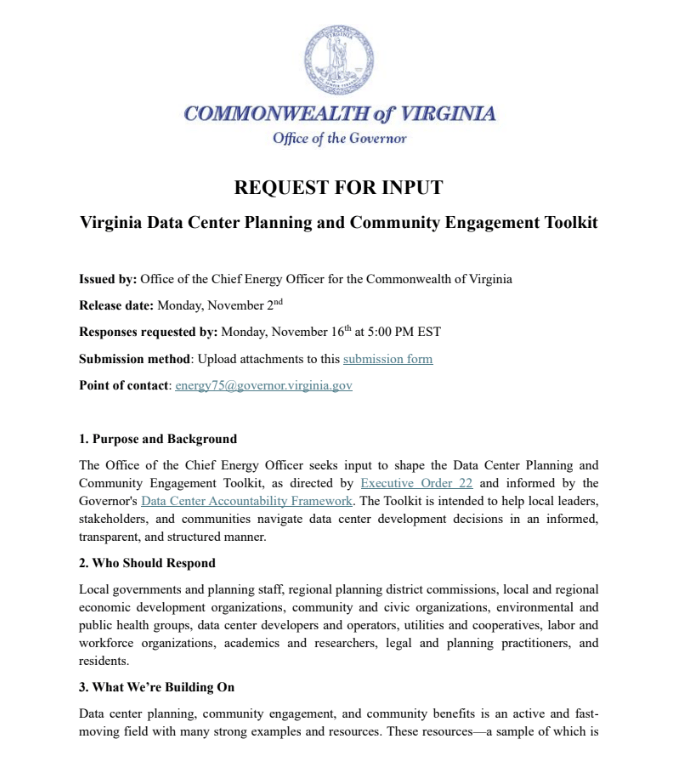
Appended to the end of this list, as something of an afterthought, is “residents.”
This recitation alone should be enough to convince you that this document is fully committed to stakeholder capitalism, but let’s have another taste.
“Community engagement: What examples or case studies demonstrate successful community engagement strategies associated with data center development or other major economic development projects?
a. What practices helped foster early, accessible, transparent, and good-faith engagement, including the timing and frequency of engagement, identification of stakeholders, methods for sharing information and gathering feedback, and coordination between localities and developers?
b. What should be the role of local representatives, industry, and other stakeholders in community engagement efforts in leading engagements and community negotiations?
c. What lessons should the Toolkit incorporate to support meaningful and ongoing engagement throughout the project lifecycle?”
This is a deeply cynical document. In Botetourt, there was no failure of “coordination between localities and developers”: the supine Board of Supervisors followed Google’s precise instructions to the letter. Similarly, there was no lack of community engagement: Google, the Water Authority, and Appalachian Power hosted a series of vacuous “open houses” or “town halls.” The problem in Botetourt, as in Roanoke, is that the people were never consulted, or even notified, before a decision was made concerning the introduction of a technology which threatens our most essential resources. Nothing in this Request for Input challenges this program of secrecy in decision making.
To state this problem, unaddressed by Spanberger’s directive, a little differently: Economic development entities like the RRP, ostensibly created for the benefit of locals, are purchasable by foreign and local corporations. Historically, Carilion has been one of the RRP’s biggest funders, and now Google, partnered with Carilion in “AI Ready Roanoke,” joins in. Local citizens have little hope of benefitting from this partnership, and even less of directing it.
The goal of Spanberger’s toolkit seems to be the discovery of more ingenious methods of making the ignorant masses take their data center medicine. How else can we read that first sentence?: “What examples or case studies demonstrate successful community engagement strategies associated with data center development?”
I defy anyone to square this with Virginia’s constitution:
“Article I. Bill of Rights
Section 2. People the source of power
That all power is vested in, and consequently derived from, the people, that magistrates are their trustees and servants, and at all times amenable to them.”
As a digestif, I leave you with an email from Google’s Clay Allsop suggesting that John Hull “add some of [his] own voice” into his press release concerning Google’s disgusting Roanoke Outside contribution:

According to its website, “The Roanoke Outside Foundation is a 501(c)3 organization and is part of the Roanoke Regional Partnership family, which also includes Get2KnowNoke.”
Also in this series:
Vampire Pimps: AECOM’s Botetourt County Museum
Vampire Pimps: The Virginia Energy Plan’s Green Vandalism
Vampire Pimps: Hull, Cobb, & Corporate Voodoo
Vampire Pimps: Roanoke and the Western Virginia Regional Industrial Facilities Authority
Vampire Pimps: AI Ready Roanoke
Vampire Pimps: Going Regional, Going Global
Delegate Terry Austin: A Primer on Evasive Political Flatulence
Vampire Pimps: In Their Own Words
Private Betrayal, Public Defiance: Botetourt’s Board of Supervisors
Vomitous Prattle & Statutory Conspiracy: The 2026 Comprehensive Plan
The 2026 Comprehensive Plan: Bend Over
The Botetourt Data Center, The Planning Commission, and Broken Promises
The Botetourt Data Center: Vampire Pimps
The Botetourt Data Center: The Legacy of Fascism
The Botetourt Data Center & the Lie of Freedom
If It’s Not Love, Then It’s the Data Center That Will Bring Us Together
The Botetourt Data Center: A Bad Deal with a Scammy Cherry on Top
The Botetourt Data Center, The Water Authority, and an Invitation to Corruption
The Botetourt Data Center: Bilious Corporate Prerogative
The Botetourt Data Center: Don’t Fear the Hamster Kaiju
Follow these groups for more information: