Notes for 10/3/26 SWVA DCTA Meeting
The following were my notes for the talk I gave this weekend:
If you’re interested in data centers in the Roanoke Valley, sooner or later you’ll come across Gary Larrowe. His email signature reads “The World belongs to those who show up.” That’s true enough, but Gary also knows WHERE to show up:
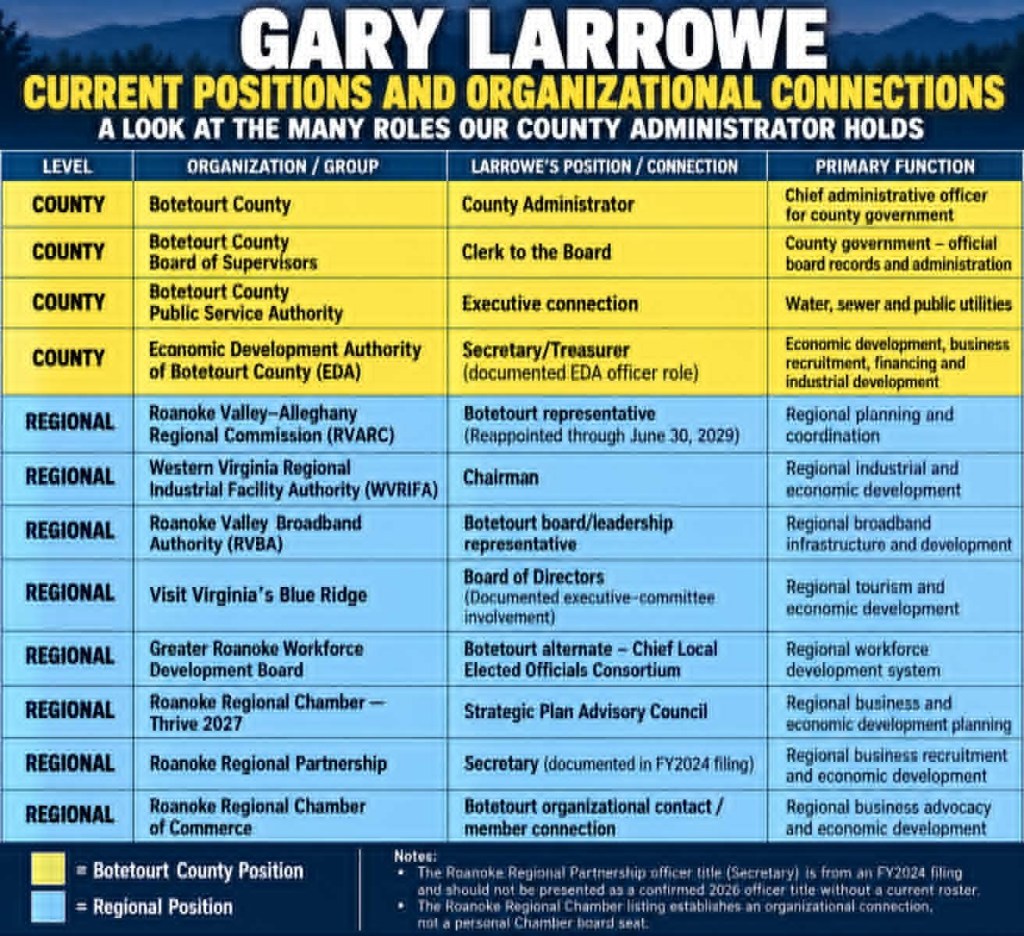
My involvement with data center opposition began with curiosity: how could Botetourt’s board of supervisors take a vote to drain Roanoke’s water? I quickly learned that the Water Authority is NOT a public utility, but a government/corporate hybrid that runs like a private company. It can make what contracts it likes.
I started finding these corporate/government hybrids all over the data center deals. I learned that a huge amount of the important decision making in the Commonwealth is made outside of the political process. To cut to the chase, the Commonwealth is largely governed by at least 3 parallel but cooperating hierarchies:
1. Chambers of Commerce;
2. The Economic Development “P3 Pipeline;” and
3. The GO Virginia program.
Before I get started a DISCLAIMER. I’m going to be talking about entities and networks largely created by statute. The activities of these networks sometimes resemble a statewide conspiracy, especially in view of their frequent use of non-disclosure agreements and closed sessions. It does not follow that the people who enacted the legislation, or the people who participate in these networks, are evil. Many of them doubtless have good intentions.
My interest is in incentive structures. I’ve given the example before of the Webb-Pomerene Act of 1918. This Antitrust act permitted US corporations to form cartels in foreign countries. At the time of its passage, Germany’s crippled economy offered the cheapest investment. And this is why American firms ended up funding Hitler. This isn’t to say that US legislators and investors set out in 1918 to create Nazism, but the incentives led them there.
Similarly here, various legislative enactments in the Virginia Code created a network which led us to backroom deals and data centers. It’s possible there were self-interested actions or bad intentions here and there, but the incentive structure is enough to account for where we’ve got.
Back to the hierarchy:
1. The Chambers of Commerce require little explanation (operate under Nonstock Corporation Act, Va. Code Title 13.1, Chapter 10)
2. The Economic Development “P3 Pipeline”
P3 stands for “public-private partnerships.” These are entities that enjoy the authority and prestige of government, and exercise traditional government functions, without any real responsibility to the public.
The P3s we’re concerned with are Economic Development Authorities (EDAs). The act which authorizes EDAs requires (§ 15.2-4901) that development authorities’ powers “shall be exercised for the benefit of the inhabitants of the Commonwealth,” but that “benefit” is to be derived by “inducing manufacturing, industrial, governmental, nonprofit, and commercial enterprises…to locate in…the Commonwealth and further the use of its agricultural products and natural resources.”
It “induces” foreign “enterprises” to use the Commonwealth’s “agricultural products and natural resources.” It’s easy to see how this could take an exploitative turn.
There is an EDA hierarchy running as follows:
Local EDAs, Water Authorities, Power Companies→Western Virginia Regional Industrial Facilities Authority (WVRIFA)→Roanoke Regional Partnership (RRP)→Roanoke Valley-Allegheny Regional Commission (RVARC)→Virginia Economic Development Partnership (VEDP)
EDAs: board appointed by Board of Supervisors (Title 15.2, Chapter 49)
WVRIFA: members appointed by BoS of participating counties (Title 15.2, Chapter 64)
RRP: 501(c)(6) public-private partnership, non-official CEO and staff
RVARC: at least a majority must be elected officials (Title 15.2, Chapter 42)
VEDP (Title 2.2, Chapter 22):
§ 2.2-2235.1. Board of directors; members and officers; Chief Executive Officer
A. The Authority shall be governed by a board of directors (the Board) consisting of the Secretary of Commerce and Trade, the Secretary of Finance, the Chairman of the Virginia Growth and Opportunity Board, the Executive Director of the Virginia Port Authority, and the Staff Directors of the House Committee on Appropriations and the Senate Committee on Finance and Appropriations, serving as ex officio, voting members, and 11 voting members to be appointed as follows:
1. Seven nonlegislative citizen members appointed by the Governor; and
2. Four nonlegislative citizen members appointed by the Joint Rules Committee.
B. 1. Each of the nonlegislative citizen members appointed by the Governor and the Joint Rules Committee shall possess expertise in at least one of the following areas: marketing; international commerce; finance or grant administration; state, regional, or local economic development; measuring the effectiveness of incentive programs; law; information technology; transportation; workforce development; manufacturing; biotechnology; cybersecurity; defense; energy; or any other industry identified in the comprehensive economic development policy developed pursuant to § 2.2-205.
This is a pretty tight and integrated hierarchy, but the presence of public officials on some of the boards allows for a degree of political pressure to be brought to bear.
The GO (Growth and Opportunity) Board was established in 2016. Its effect, whether intended or not, is:
a. To further integrate the P3 Pipeline; and
b. To put the P3 Pipeline under corporate control.
3. GO Virginia
§ 2.2-2485. Virginia Growth and Opportunity Board; membership; terms; compensation.
A. The Virginia Growth and Opportunity Board is established as a policy board in the executive branch of state government.
§ 2.2-2485. Virginia Growth and Opportunity Board; membership; terms; compensation.
B. The Board shall have a total membership of 25 members that shall consist of seven legislative members, 14 nonlegislative citizen members, and four ex officio members.
§ 2.2-2486. Powers and duties of the Board.
A. The Board shall have the power and duty to:
1. Designate regions for the purpose of administering this article;
2. Certify qualifying regions and regional councils, including developing and implementing guidelines or procedures for such certification;
3. Develop and implement guidelines and procedures for the application for and use of any moneys in the Fund;
4. Receive and assess applications for awards from the Fund submitted by regional councils and determine the distribution, duration, and termination of awards from the Fund for uses identified in such applications;
§ 2.2-2487. Virginia Growth and Opportunity Fund.
A. There is hereby created in the state treasury a special nonreverting fund to be known as the Virginia Growth and Opportunity Fund.
B. Moneys in the Fund shall be used to facilitate regional collaboration on economic growth and diversification. Specifically, the Fund shall be used to incentivize and encourage cooperation among business, education, and government on regional strategic economic development and workforce development efforts.
§ 2.2-2488. Formation of regional councils.
A. A regional council may be established in each region identified by the Board. Regional councils shall solicit, review, and recommend regional activity projects to the Board in accordance with this article.
Roanoke and Botetourt are in GO Virginia’s Region 2. Region 2 “council members” currently include representatives from:
Southern Air
Good Will
Sonny Merryman
Skyline Capital Strategies
IV Labs, Inc
American Electric Power
Virginia Tech
Virginia Western
Radford Un iversity
Branch Builds
AECOM
P1 Technologies
Graham White
Wood Rogers
Roanoke College
Merry Go Round Farms
PLDR Law
Aerofin
Central Virginia Community College
Allegheny County’s County Administrator
New River Valley Regional Commission
Fralin Biomedical Research Institute
MELD Manufacturing and Aeroprobe Corporation
New River/Mount Rogers Workforce Development Foundation
Kubota
Liberty University
TECHLAB
Carilion
ARCO Innovations
Hurt & Profitt
GO VIRGINIA is, for all intents and purposes, corporate controlled. That’s not to say that any of these representatives, or the companies they work for, are evil. The Virginia Growth and Opportunity Fund does however exercise great influence over the P3 Pipeline, and it’s not meaningfully subject to political pressure.
AI Ready Roanoke brings all 3 hierarchies together:
1. Its executive committee is filled with people from local EDAs, and John Hull of the Roanoke Regional Partnership.
2. It relies upon the “2025 Virginia Chamber AI Landscape Assessment”
3. It depends upon funding from the GO Virginia program
These data centers and the rest of AI Ready Roanoke have been in the works since at least 2022. You can find traces of it all in the publicly available planning documents of VEDP, RVARC, and GO Virginia. The latter’s document, for example, prepared in 2022 specifically mentions Wood Haven.
This stuff may be coordinated from above, but there are still local choke points in the boards of supervisors, planning commissions, and EDAs. Here’s some stuff to look out for:
Doing a Wood Haven, i.e. closed session & vote without identifying subject of vote
“Walk on items” not noticed in the agenda packet
Joint sessions of BoS and planning
Land-use decisions:
-Petition v. Resolution: Resolution the proper method for county-initiated change
-Are they articulating how proposed use is consistent with Comprehensive Plan?
-Has it been submitted to planning for consistency with Comprehensive Plan?
-Are they stating a public purpose for the change?
-Are they articulating the public purposes of 15.2-2283 and 15.2-2284?
-Notices adequate under 15.2-2204?
FOIA: applies to all meetings of government or hybrid bodies
-Agenda available before meeting?
-Are they taking adequate minutes?
-Are they posting the minutes within 7 days?
-Written request for notification
Relevant portions of relevant statutes follow:
§ 15.2-2230.1. Public facilities study.
In addition to reviewing the comprehensive plan, the planning commission may make a study of the public facilities, including existing facilities, which would be needed if the comprehensive plan is fully implemented….For purposes of the study, public facilities may include but need not be limited to water and sewer lines and treatment plants
§ 15.2-2232. Legal status of plan.
A. Whenever a local planning commission recommends a comprehensive plan or part thereof for the locality and such plan has been approved and adopted by the governing body, it shall control the general or approximate location, character and extent of each feature shown on the plan. Thereafter, unless a feature is already shown on the adopted master plan or part thereof or is deemed so under subsection D, no…public structure, public utility facility or public service corporation facility …shall be constructed, established or authorized, unless and until the general location or approximate location, character, and extent thereof has been submitted to and approved by the commission as being substantially in accord with the adopted comprehensive plan or part thereof. In connection with any such determination, the commission may, and at the direction of the governing body shall, hold a public hearing, after notice as required by § 15.2-2204….
§ 15.2-2283. Purpose of zoning ordinances.
Zoning ordinances shall be for the general purpose of promoting the health, safety or general welfare of the public and…shall be designed to give reasonable consideration to each of the following purposes, where applicable: (i) to provide for adequate light, air, convenience of access, and safety from fire, flood, impounding structure failure, crime and other dangers; (ii) to reduce or prevent congestion in the public streets; (iii) to facilitate the creation of a convenient, attractive and harmonious community; (iv) to facilitate the provision of adequate…water, …(v) to protect against destruction of or encroachment upon historic areas…(vi) to protect against one or more of the following: overcrowding of land, undue density of population in relation to the community facilities existing or available…danger and congestion in travel and transportation…(viii) to provide for the preservation of agricultural and forestal lands and other lands of significance for the protection of the natural environment;…Such ordinance may also include reasonable provisions, not inconsistent with applicable state water quality standards, to protect surface water and ground water as defined in § 62.1-255.
§ 15.2-2284. Matters to be considered in drawing and applying zoning ordinances and districts.
Zoning ordinances and districts shall be drawn and applied with reasonable consideration for the existing use and character of property, the comprehensive plan, the suitability of property for various uses,… the conservation of natural resources,…the preservation of agricultural and forestal land, the conservation of properties and their values and the encouragement of the most appropriate use of land throughout the locality.
§ 15.2-2286. (Effective until January 1, 2027) Permitted provisions in zoning ordinances; amendments; applicant to pay delinquent taxes; penalties.
…Whenever the public necessity, convenience, general welfare, or good zoning practice requires, the governing body may by ordinance amend, supplement, or change the regulations, district boundaries, or classifications of property. Any such amendment may be initiated (i) by resolution of the governing body; (ii) by motion of the local planning commission; or (iii) by petition of the owner, …Any such resolution or motion by such governing body or commission proposing the rezoning shall state the above public purposes therefor.
§ 15.2-2204. Advertisement of plans, ordinances, etc.; joint public hearings; written notice of certain amendments.
A. Plans or ordinances, or amendments thereof, recommended or adopted under the powers conferred by this chapter need not be advertised in full, but may be advertised by reference. Every such advertisement shall identify the place or places within the locality where copies of the proposed plans, ordinances or amendments may be examined.
The local planning commission shall not recommend nor the governing body adopt any plan, ordinance or amendment thereof until notice of intention to do so has been published twice in some newspaper published or having general circulation in the locality, with the first notice appearing no more than 28 days before and the second notice appearing no less than five days before the date of the meeting referenced in the notice; however, the notice for both the local planning commission and the governing body may be published concurrently. The notice shall specify the time and place of hearing at which persons affected may appear and present their views. The local planning commission and governing body may hold a joint public hearing after public notice as set forth in this subsection. If a joint hearing is held, then public notice as set forth in this subsection need be given only by the governing body. In any instance in which a locality has submitted a correct and timely notice request to such newspaper and the newspaper fails to publish the notice, or publishes the notice incorrectly, such locality shall be deemed to have met the notice requirements of this subsection so long as the notice was published in the next available edition of a newspaper having general circulation in the locality. After enactment of any plan, ordinance or amendment, further publication thereof shall not be required.
§ 2.2-3707. Meetings to be public; notice of meetings; recordings; minutes.
A. All meetings of public bodies shall be open, except as provided in §§ 2.2-3707.01 and 2.2-3711.
…
D. Every public body shall give notice of the date, time, location, and remote location, if required, of its meetings by:
1. Posting such notice on its official public government website, if any;
2. Placing such notice in a prominent public location at which notices are regularly posted; and
3. Placing such notice at the office of the clerk of the public body or, in the case of a public body that has no clerk, at the office of the chief administrator.
…
F. Any person may annually file a written request for notification with a public body. The request shall include the requester’s name, address, zip code, daytime telephone number, electronic mail address, if available, and organization, if any. The public body receiving such request shall provide notice of all meetings directly to each such person. Without objection by the person, the public body may provide electronic notice of all meetings in response to such requests.
G. At least one copy of the proposed agenda and all agenda packets and, unless exempt, all materials furnished to members of a public body for a meeting shall be made available for public inspection at the same time such documents are furnished to the members of the public body. The public body shall also post the proposed agenda on the public body’s official government website, if any, prior to the meeting. No final action may be taken on items added to the agenda after the meeting commences unless they are time-sensitive or are the subject of a closed meeting properly identified in a motion in accordance with § 2.2-3711.
…
I. Minutes shall be taken at all open meetings.
…
Minutes, including draft minutes, and all other records of open meetings, including audio or audio/visual records, shall be deemed public records and subject to the provisions of this chapter.
Minutes shall be in writing and shall include (a) the date, time, and location of the meeting; (b) the members of the public body recorded as present and absent; and (c) a summary of the discussion on matters proposed, deliberated, or decided, and a record of any votes taken. In addition, for electronic communication meetings conducted in accordance with § 2.2-3708.2 or 2.2-3708.3, minutes shall include (1) the identity of the members of the public body who participated in the meeting through electronic communication means, (2) the identity of the members of the public body who were physically assembled at one physical location, and (3) the identity of the members of the public body who were not present at the location identified in clause (2) but who monitored such meeting through electronic communication means.
§ 2.2-3707.2. Posting of minutes for local public bodies.
Except as provided in subsection I of § 2.2-3707, any local public body subject to the provisions of this chapter shall post minutes of its meetings on its official public government website, if any, within seven working days of final approval of the minutes.